
What pages should every small business website have?
What Pages Should Every Small Business Website Have? When a small business decides to build a website, one of the first questions is often: How many pages do…
In this article
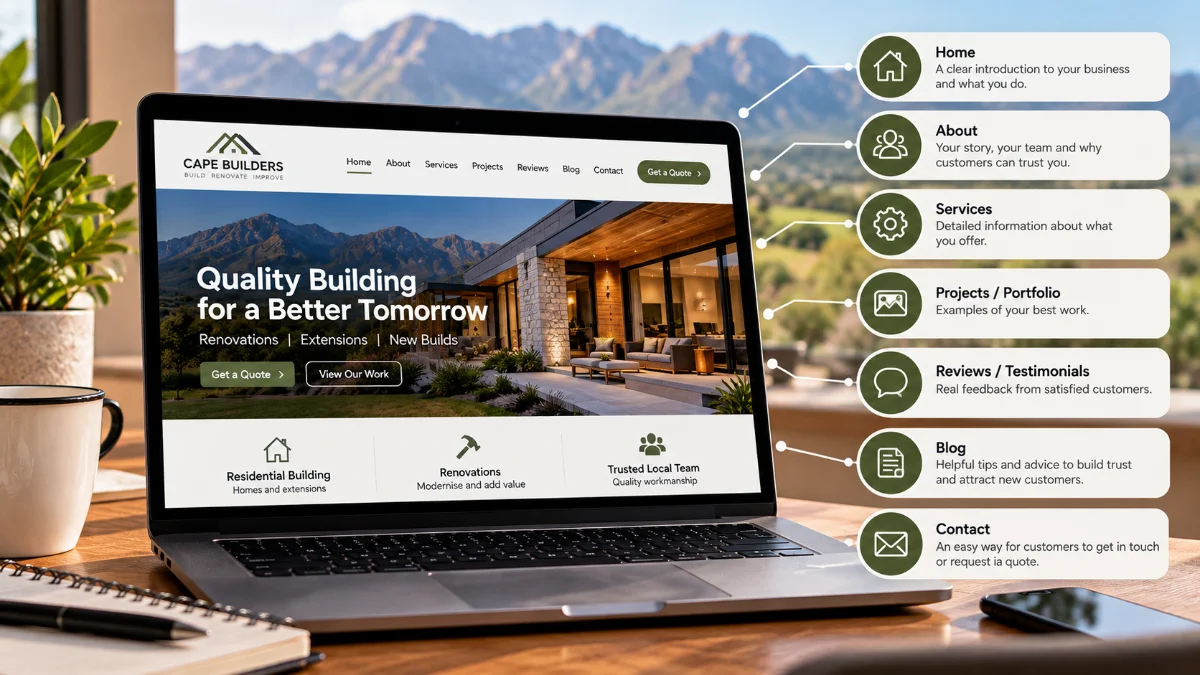
- 1. Homepage: Make a strong first impression
- 2. Services page: Explain what you actually offer
- 3. About page: Give people a reason to trust you
- 4. Contact page: Make the next step easy
- 5. Portfolio, Projects or Testimonials: Show what you can do
- Do you need a blog?
- What about pricing, FAQs and booking pages?
- Could a one-page website be enough?
- Build around the customer, not a page count
- Is your current website doing its job?
What Pages Should Every Small Business Website Have?
When a small business decides to build a website, one of the first questions is often:
How many pages do I actually need?
It’s a reasonable question, especially when you’re trying to manage costs while creating a professional online presence.
Some websites have dozens of pages. Others have just three or four.
But here’s something worth remembering: the number of pages matters less than what those pages help your customers achieve.
A well-planned five-page website can be far more useful than a complicated 20-page website that leaves visitors confused.
Let’s look at the essential pages most South African small businesses should consider, what each should accomplish and where additional pages might make sense.
1. Homepage: Make a strong first impression
Your homepage is often the first introduction a potential customer has to your business.
Within a few seconds, visitors should understand three things:
- What your business does.
- Who you help or where you operate.
- What they should do next.
Imagine visiting an electrician’s website.
A headline saying “Welcome to Our Website” tells you very little.
Something like “Professional Electrical Installations and Repairs in Worcester” immediately provides useful information.
Add a brief description, genuine project photographs and a clear quotation button, and the visitor has a reason to explore further.
Your homepage shouldn’t simply welcome visitors. It should help them understand why they’ve come to the right place.
2. Services page: Explain what you actually offer
This is one of the most important pages for a service-based business.
Potential customers shouldn’t have to guess what work you do.
Your services page should explain your main offerings in straightforward language.
For example, a building contractor might include:
- New residential construction
- Renovations and extensions
- Roof repairs
- General building maintenance
- Project quotations
Each service should explain what is included, who it’s suitable for and how someone can enquire.
If your business offers several distinct services, separate service pages may be worthwhile.
A plumber, for example, could have dedicated pages for geyser installations, blocked drains and emergency plumbing.
These pages can also help Google understand the specific services your business provides.
However, don’t create extra pages simply to make the website appear larger. Every page should serve a genuine purpose.
3. About page: Give people a reason to trust you
Small businesses have something valuable that large companies sometimes struggle to communicate: personality.
Customers often want to know who they’re dealing with before inviting someone onto their property, booking a service or spending money.
Your About page is an opportunity to build that confidence.
It can include:
- How the business started.
- The people behind the business.
- Your experience and relevant qualifications.
- Your approach to customer service.
- The towns or regions you serve.
- What makes your business different.
Whenever possible, use genuine photographs of the business owner, team or workplace.
A real photograph and an honest explanation of how you work are often more convincing than generic claims about being passionate, professional and committed to excellence.
People don’t only buy services. They also decide whether they trust the people providing them.
4. Contact page: Make the next step easy
You might be surprised how difficult some websites make it for customers to get in touch.
Telephone numbers are hidden in footers. Contact forms ask too many questions. Addresses are missing. And sometimes visitors have no idea whether the business serves their area.
Your Contact page should remove these obstacles.
Depending on your business, include:
- A clickable telephone number.
- A professional email address or contact form.
- A WhatsApp contact option, where appropriate.
- Your business location or service area.
- Operating hours, if relevant.
- Clear directions for requesting a quotation or appointment.
For a business receiving project enquiries, a slightly more detailed form can actually save time.
A builder might ask about the project location, type of work and expected starting date.
An electrician might allow customers to describe a fault or upload photographs.
The important thing is to gather useful information without making the process unnecessarily complicated.
And remember to test the contact process on a mobile phone.
5. Portfolio, Projects or Testimonials: Show what you can do
Would you hire someone for an expensive renovation without wanting to see examples of their work?
Probably not.
For many small businesses, proof of previous work is one of the strongest selling tools available.
This might take the form of a project gallery, completed work examples, customer testimonials or brief case studies.
An estate agent could showcase successfully marketed properties.
A builder could present before-and-after photographs.
A graphic designer could display brand identities and completed designs.
A consultant could describe a client problem and how it was approached, while respecting confidentiality.
Not every business needs a separate portfolio page. Some may be better served by placing customer testimonials and examples directly alongside their services.
The objective is not simply to display attractive photographs. It’s to help prospective customers feel confident about choosing your business.
Do you need a blog?
Not every small business needs one immediately.
A blog can be valuable when you have useful information to share and can maintain it consistently.
For example, an electrician might explain common electrical safety concerns.
A property agent could discuss preparing a house for sale.
A guesthouse could publish guides to local attractions and activities.
Useful articles can answer customer questions, support relevant Google searches and demonstrate expertise.
But a neglected blog filled with outdated or repetitive content can create more work than value.
Start with your essential pages. Add articles when they support a clear business purpose.
What about pricing, FAQs and booking pages?
These depend on how your business operates.
A website for a guesthouse might need accommodation details, availability and booking facilities.
An online shop needs product pages, a basket, checkout and appropriate delivery and returns information.
A consultant might benefit from detailed service explanations and frequently asked questions.
Some businesses should publish clear prices. Others, particularly those providing customised services, may be better served by explaining how quotations work.
You might also need legal and policy pages appropriate to your operations, such as privacy, returns or website terms.
The goal is to include what customers actually need, not follow a fixed template.
Could a one-page website be enough?
Yes, in certain circumstances.
A simple one-page website can work well for a small business with a limited range of services and a straightforward customer journey.
It can introduce the business, explain its offerings, provide evidence of credibility and make it easy to get in touch.
However, as the business expands, separate pages can make information easier to organise and give individual services more room to be explained properly.
A good website should be able to grow with the business.
Build around the customer, not a page count
Before deciding how many pages your website needs, imagine a potential customer visiting it for the first time.
Ask yourself:
Can they understand what we offer?
Can they see why they should trust us?
Can they find the information they need?
Can they contact us without unnecessary effort?
If your website answers those questions clearly, you’re already moving in the right direction.
At Witzenberg Online, we believe websites should be designed around the needs of the individual business rather than built from a standard collection of pages.
An electrician, author, estate agent and tourism operator don’t have identical customers or business goals. Their websites shouldn’t be identical either.
Is your current website doing its job?
If you already have a website but aren’t sure whether it’s helping customers find, trust and contact your business, our Free 15-Point Website Checkup is a useful starting point.
It helps you review important aspects of your website, including first impressions, mobile experience, trust and the customer journey.
If you’re planning a new website, explore our website solutions or discuss your project with Witzenberg Online.
A website doesn’t need to be complicated to be effective. It needs to make sense for your business and the people you’re trying to reach.

Build a website that works as hard as your business does.
Professional web design, practical digital support and a clearer path from online attention to real enquiries.
Why your business needs more than a Facebook page
Why Your Business Needs More Than a Facebook Page For many South African small businesses, Facebook is where…
Read article
How South African small businesses can compete online
How South African Small Businesses Can Compete Online South African small businesses often compete against companies with bigger…
Read article
Website and Social Media Tips for Local Service Businesses: 10 Ways to Get More Enquiries
For a local service business, having a website and a Facebook or Instagram page is no longer enough.…
Read article