
Why your business needs more than a Facebook page
Why Your Business Needs More Than a Facebook Page For many South African small businesses, Facebook is where their online journey begins. It's familiar, relatively easy to use…
In this article
- 1. Your Facebook page is not entirely under your control
- 2. Customers shouldn’t have to search for basic information
- 3. Your website can help customers discover you through Google
- 4. Your website can become a proper enquiry system
- 5. A website can show the full value of your business
- 6. Facebook and your website should work together
- 7. Does your business need an expensive website?
- The next step for your business
Why Your Business Needs More Than a Facebook Page
For many South African small businesses, Facebook is where their online journey begins.
It’s familiar, relatively easy to use and gives business owners a way to share photographs, promote their services, communicate with customers and build an audience.
And there’s nothing wrong with that.
The problem begins when Facebook becomes your entire online presence.
A potential customer might discover your business through a social media post, but what happens when they want more information?
Can they easily find your services, prices, completed projects, contact details and business location? Or must they scroll through months of posts hoping to find the answers?
That’s where having your own website can make a real difference.
1. Your Facebook page is not entirely under your control
When you operate a business page on Facebook, you’re using someone else’s platform.
Changes to the way content is displayed, distributed or linked can affect how easily people discover your business.
Your followers don’t necessarily see every post you publish. And the way you communicate with your audience is influenced by the platform’s rules and features.
A business website offers a different advantage.
You control the content, presentation and customer journey.
You can organise information around what your customers need, rather than how a social media feed happens to display it.
Of course, your website still depends on hosting, domain registration and technical maintenance. But it gives you significantly more control over your digital presence.
2. Customers shouldn’t have to search for basic information
Imagine someone needs an electrician in Worcester.
They find an electrical business on Facebook and want to know whether it handles residential installations, fault-finding or compliance certificates.
If that information is scattered across old posts, the potential customer must work to find it.
Now imagine the same business has a well-organised website with clear service descriptions, contact details, areas served and a straightforward quotation form.
The customer can quickly understand whether the business is suitable.
This doesn’t guarantee an enquiry, but it removes unnecessary obstacles.
A good business website should make it easy for customers to choose you.
3. Your website can help customers discover you through Google
Facebook posts and business websites are not discovered in exactly the same way.
When someone searches Google for a service, a relevant website can provide dedicated pages explaining what the business offers and where it operates.
For example, a plumbing business could have pages covering blocked drains, geyser repairs, emergency plumbing and its service areas.
Each page can answer a specific customer question and offer an appropriate next step.
A Facebook page may also appear in search results, but a website gives you more flexibility to structure and optimise individual pages.
A website doesn’t automatically guarantee high Google rankings. It requires useful content, sound technical foundations and ongoing attention.
But it creates opportunities that a social media page alone may not provide.
4. Your website can become a proper enquiry system
One of the most important differences between a social media page and a business website is how enquiries can be handled.
A customer might send a Facebook message asking for a quotation.
That can work perfectly well.
But a website can capture additional details that make the enquiry more useful.
For example:
- An electrician can request the type of work, location and photographs.
- A builder can ask about the project, expected timeline and approximate budget.
- An estate agent can provide a property valuation enquiry.
- A guesthouse can direct visitors towards availability and booking information.
- A consultant can ask which service the visitor needs.
These aren’t simply contact forms.
They’re opportunities to make the customer’s journey easier while helping the business respond more effectively.
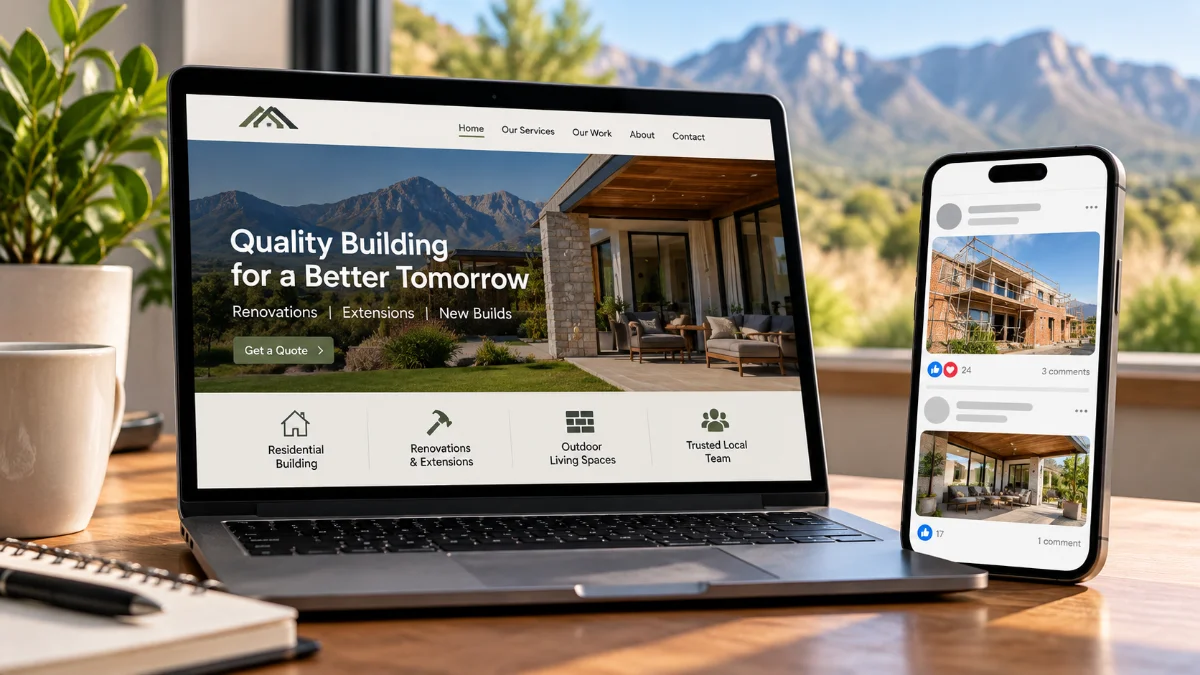
5. A website can show the full value of your business
Social media is excellent for sharing individual moments.
A completed project. A happy customer. A special offer. A photograph of work in progress.
A website allows you to bring those individual pieces together into a more complete picture.
You can showcase your best projects, explain how you work, introduce your team, publish customer testimonials and answer frequently asked questions.
For businesses offering higher-value services, that additional information can be particularly important.
A customer considering a substantial building project or professional service usually wants more than a few photographs before making contact.
They want to understand who they’re dealing with and whether the business is credible.
6. Facebook and your website should work together
This isn’t an argument for abandoning Facebook.
In fact, we believe social media and websites are often more valuable when they support each other.
Facebook and Instagram can help people discover your business, become familiar with your work and interact with your brand.
Your website can then provide the detailed information, reassurance and enquiry process needed to turn that interest into a business opportunity.
And email marketing can help you maintain relationships with people who have chosen to hear from you.
Each channel has a different role.
Social media creates opportunities for discovery. Your website gives interested customers a place to take the next step.
You don’t have to choose one or the other.
7. Does your business need an expensive website?
Not necessarily.
A small local service business may only need a professional, mobile-friendly website with a few carefully planned pages.
The important thing is not how many features the website contains.
It’s whether the website helps customers do what they came to do.
Before investing in a website, ask yourself:
- Can potential customers quickly understand what we offer?
- Can they find our contact details without searching?
- Does the website demonstrate why they should trust us?
- Can they make an enquiry easily from a mobile phone?
- Does it support the goals of our business?
A straightforward website that answers these questions can be more valuable than a complicated website filled with unnecessary features.
The next step for your business
If your business currently relies mainly on Facebook, consider what happens when someone wants to learn more about you.
Where do they go? What information will they find? How easily can they contact you?
You may discover that a simple, well-planned website would make a significant difference.
And if you already have a website, the question becomes whether it’s actually doing its job.
Not sure where your website could improve?
Start with the free 15-point Website Checkup. It’s designed to help South African small business owners assess their websites, identify possible weaknesses and decide what deserves attention.
If you’re ready to explore a new website, have a look at our website solutions or discuss your project with Witzenberg Online.
Your business deserves more than simply being visible online. It deserves a digital presence that helps customers find you, trust you and get in touch.

Build a website that works as hard as your business does.
Professional web design, practical digital support and a clearer path from online attention to real enquiries.
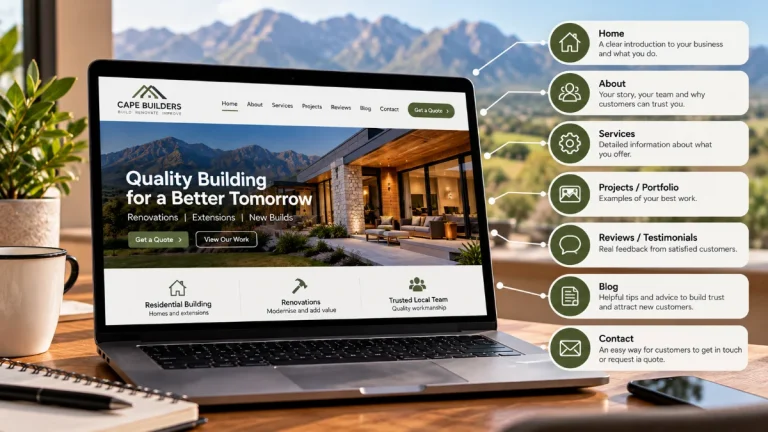
What pages should every small business website have?
What Pages Should Every Small Business Website Have? When a small business decides to build a website, one…
Read article
How South African small businesses can compete online
How South African Small Businesses Can Compete Online South African small businesses often compete against companies with bigger…
Read article
Website and Social Media Tips for Local Service Businesses: 10 Ways to Get More Enquiries
For a local service business, having a website and a Facebook or Instagram page is no longer enough.…
Read article