
How Much Should an Electrician Website Cost in South Africa?
Ask five South African web designers what a website costs and you may get five completely different answers. R1,500. R5,000. R15,000. R40,000. R500 per month. And technically, all…
In this article
- What Do Websites Cost in South Africa in 2026?
- The R2,000 Website
- A Professional Small-Business Website
- What Actually Affects the Price?
- Do You Own the Website?
- Should an Electrician Use a DIY Website Builder?
- Do Not Judge a Quote Only by Page Count
- What Should an Electrician Budget?
- The Better Question: What Is One Customer Worth?
- Start With the Right Size Website
Ask five South African web designers what a website costs and you may get five completely different answers.
R1,500.
R5,000.
R15,000.
R40,000.
R500 per month.
And technically, all of them could be legitimate quotations.
That is because “a website” is not a standard product.
It is a little like asking:
How much does electrical work cost?
Are we replacing one plug?
Rewiring a house?
Installing a new DB board?
Working on a shopping centre?
The scope matters.
Websites are no different.
What Do Websites Cost in South Africa in 2026?
Current published South African pricing illustrates just how wide the market is.
One 2026 pricing guide places basic one-page websites at roughly R1,500 to R8,000, while another places typical small-business websites in the region of R5,000 to R20,000 depending on scope. Procompare currently lists a simple CMS website at approximately R3,800 to R6,300.
Those numbers should be treated as market indicators, not a tariff.
The important question is not simply:
What does the website cost?
It is:
What am I getting for the money?
The R2,000 Website
Can somebody build an electrician website for R2,000?
Absolutely.
It might even look decent.
A low-cost website can make sense for a new one-person business that simply needs:
- A home page
- Basic services
- Contact details
- A WhatsApp button
- A domain presence
There is nothing automatically wrong with starting small.
The danger comes when a cheap website is sold as though it includes a complete digital strategy.
At the lower end of the market, ask carefully what is and is not included.
A Professional Small-Business Website
For an established electrician, the website generally needs to do more.
You may need:
- Customised design
- Multiple service pages
- Mobile optimisation
- Quote or enquiry forms
- WhatsApp integration
- Project galleries
- Testimonials
- Local SEO foundations
- Google integration
- Analytics
- Security
- Hosting
- Backups
- Ongoing support
Once the scope expands, so does the cost.
That is normal.
What Actually Affects the Price?
Number of Pages
A one-page site takes less work than a website containing separate sections for:
- Residential electrical work
- Commercial work
- Electrical maintenance
- Fault finding
- Certificates of Compliance
- Solar installations
- Projects
- About
- Contact
More pages mean more design, content and testing.
Copywriting
Who supplies the words?
If the electrician provides polished website copy, the designer has less content work to do.
If the web company needs to research the industry, structure each page and write the content, that adds value and time.
Good copy is not simply there to fill white space.
It helps customers understand why they should contact you.
Photography
Real project photography can dramatically improve a trade website.
If you already have excellent photographs, great.
If somebody needs to photograph projects, edit images or source additional visuals, that changes the scope.
SEO
Be careful with the phrase “SEO included.”
That could mean somebody installed an SEO plugin.
Or it could mean genuine work has gone into:
- Page structure
- Keyword research
- Service targeting
- Location relevance
- Titles and descriptions
- Internal linking
- Search Console
- Technical setup
- Content planning
Those are very different things.
Functionality
An electrician may only need a simple enquiry form.
Another company might require:
- Online appointment requests
- Quote workflows
- Careers
- Document uploads
- Customer portals
- Multiple branches
- CRM integration
Complexity adds development time.
Ongoing Support
What happens once the website launches?
Who updates it?
Who backs it up?
Who fixes something when software changes?
Who updates a service?
Who adds a new project?
Who notices when the enquiry form stops delivering mail?
A cheap build with no support can become expensive if the owner later needs to find somebody else to maintain it.
Do You Own the Website?
This is worth asking before signing anything.
Find out:
- Who owns the domain?
- Who controls the hosting?
- Can you move the website?
- Do you receive administrator access?
- What happens if you cancel a monthly package?
- Are there cancellation terms?
- Are there licence costs?
A low monthly price can be perfectly legitimate.
Just understand what you are buying.
Should an Electrician Use a DIY Website Builder?
It can work.
If you are comfortable building websites and have more available time than budget, a DIY builder can get a basic site online relatively cheaply.
But there is an opportunity cost.
An electrician could spend twenty hours learning to build a website.
A web designer could spend those same twenty hours building websites.
An electrician could spend them doing electrical work.
Neither approach is automatically right.
The question is where your time is worth more.
Do Not Judge a Quote Only by Page Count
A five-page website for R5,000 is not automatically better value than a five-page website for R10,000.
Compare what the websites are expected to achieve.
Look at:
- Quality of work
- Mobile experience
- Speed
- Copy
- Calls to action
- SEO foundation
- Support
- Security
- Hosting
- Tracking
- Content strategy
- Ownership
- Experience
- Communication
You are buying the complete result, not five digital pieces of paper.
What Should an Electrician Budget?
For a straightforward South African electrician website in 2026, the wider market suggests that several thousand rand is normal for a professionally built small-business site, with costs rising significantly as custom design, content, SEO, functionality and ongoing marketing are added. Published South African guides currently span from low-cost one-page builds to R20,000 and beyond for more developed small-business websites.
Rather than picking an arbitrary number, start with the business requirement.
If the website exists purely to prove that the company exists, keep it simple.
If you expect it to generate enquiries, rank for local searches, support advertising and form part of your sales process, budget for it as a business tool.
The Better Question: What Is One Customer Worth?
Suppose an electrician spends R8,000 on a website.
That sounds expensive compared with a R2,000 website.
Now suppose the better website consistently produces additional legitimate enquiries.
What is one:
- DB board upgrade worth?
- Commercial maintenance contract worth?
- New house installation worth?
- Solar project worth?
- Renovation worth?
Suddenly the purchase is easier to evaluate.
A business website should not be judged only by what it costs to build.
It should also be judged by what it helps the business achieve.
Start With the Right Size Website
You do not need to build everything on day one.
A good electrician website can start with the important foundations and grow.
The key is making sure those foundations are right:
Clear services.
Strong trust signals.
Real work.
Local relevance.
Good mobile design.
Easy contact.
Then build outward as the business grows.
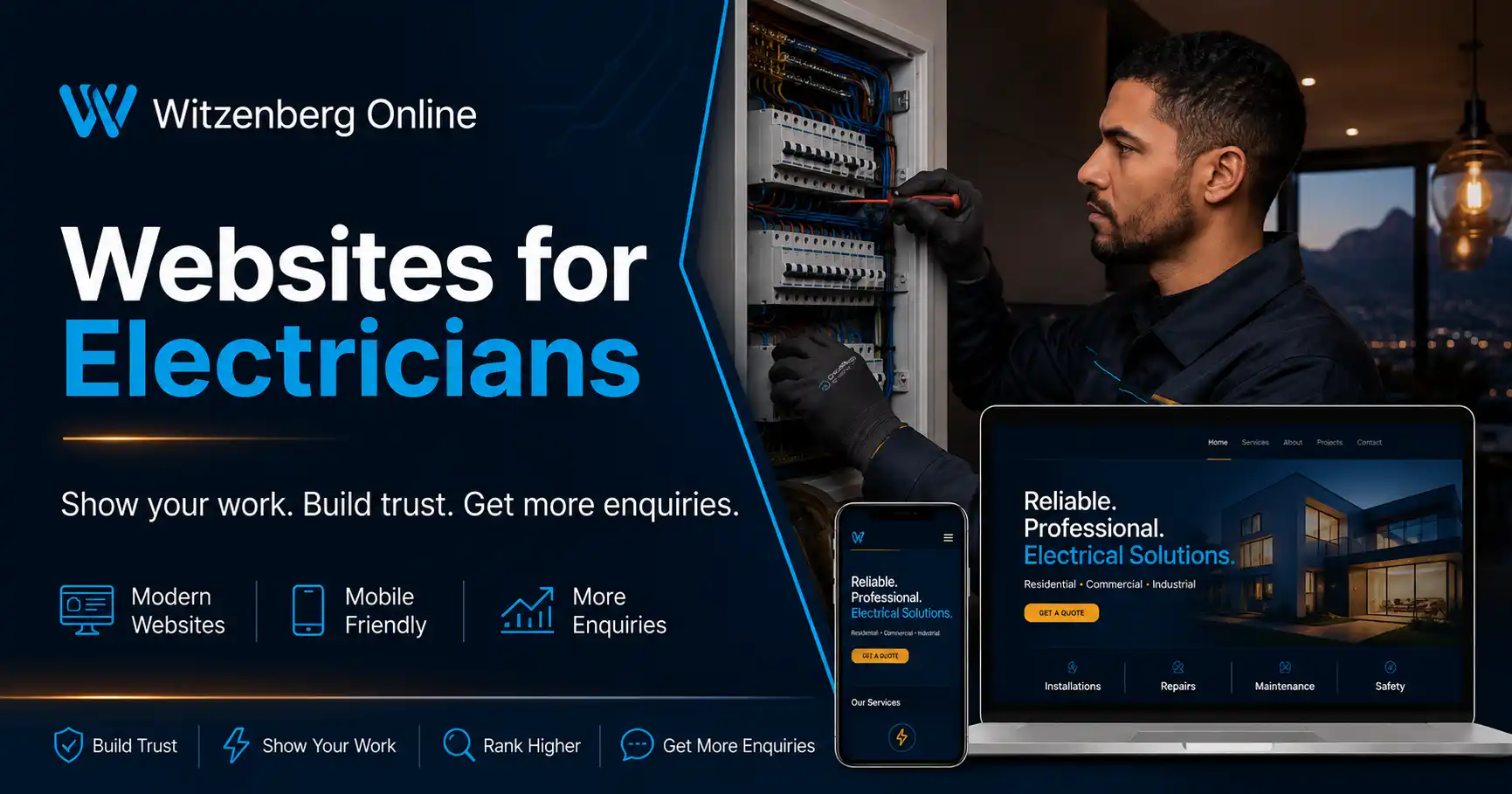
If you are comparing website options, we have created several electrician website concepts to demonstrate what is possible without forcing every electrical contractor into exactly the same template.
View our electrician website examples:
If you would like pricing for your own electrical business, Witzenberg Online can recommend a website scope based on what the site actually needs to achieve rather than simply selling you the largest package available.

Build a website that works as hard as your business does.
Professional web design, practical digital support and a clearer path from online attention to real enquiries.
How to Turn Plumbing Website Visitors Into Calls and WhatsApps
How to Turn Plumbing Website Visitors Into Calls and WhatsApps Website traffic sounds impressive. “We had 500 visitors…
Read article
How to Get Better-Quality Building Enquiries From Your Website
How to Get Better-Quality Building Enquiries From Your Website More leads. That's what almost every business says it…
Read article
Google Business Profile vs a Plumbing Website: What Does Each Actually Do?
Google Business Profile vs a Plumbing Website: What Does Each Actually Do? “My plumbing business is already on…
Read article