
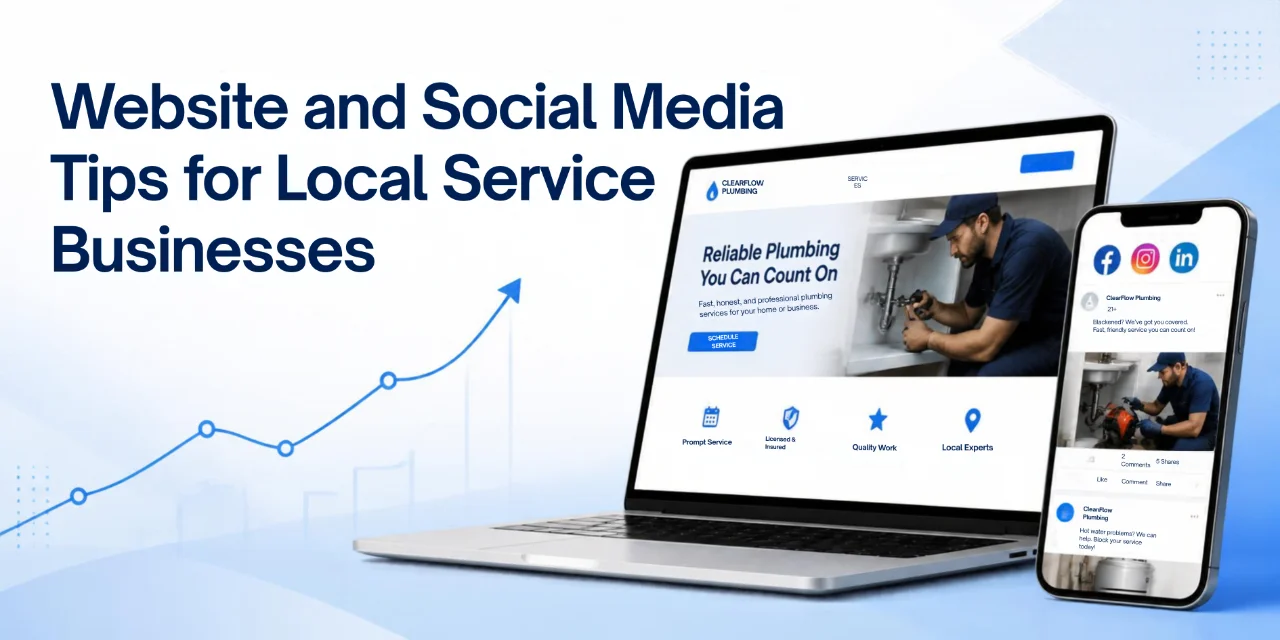
Website and Social Media Tips for Local Service Businesses: 10 Ways to Get More Enquiries
For a local service business, having a website and a Facebook or Instagram page is no longer enough. The real question is whether those platforms are helping people…
In this article
- 1. Make it immediately clear what you do
- 2. Make contacting you easy
- 3. Show your actual work
- 4. Use your service area on your website
- 5. Stop treating social media like a noticeboard
- 6. Turn every job into content
- 7. Give people a reason to trust you
- 8. Make sure your website works properly on a phone
- 9. Don’t chase followers. Chase enquiries.
- 10. Make your website and social media work together
- Keep it simple and consistent
- Is your website helping your business generate enquiries?
For a local service business, having a website and a Facebook or Instagram page is no longer enough.
The real question is whether those platforms are helping people find your business, trust you and ultimately contact you for a quote.
Whether you are a plumber, electrician, builder, landscaper, property professional or another local service provider, your online presence should be doing more than simply proving that your business exists.
It should be generating opportunities.
Here are ten practical ways to make your website and social media work harder for your business.
1. Make it immediately clear what you do
When someone lands on your website, they should understand within a few seconds:
- What service you provide
- Where you operate
- Who you help
- How they can contact you
Avoid vague introductions such as “Welcome to our website”.
A stronger opening would be something like:
Professional plumbing services in Cape Town for homes, businesses and property managers.
That immediately tells both the visitor and search engines what the business is about.
2. Make contacting you easy
One of the most common mistakes on small business websites is making visitors work too hard to get in touch.
Your phone number, WhatsApp option or quote button should be easy to find, especially on mobile devices.
If someone has a leaking pipe, electrical fault or urgent repair, they are unlikely to spend five minutes searching your website for a contact page.
A strong call to action might simply say:
Need a quote? Contact us today.
Keep it obvious and simple.
3. Show your actual work
For local service businesses, photographs can often sell your services better than several paragraphs of marketing copy.
Show:
- Completed projects
- Before-and-after photographs
- Your team at work
- Equipment and vehicles
- Recent installations
- Difficult jobs you have successfully completed
Real photographs help potential customers see that you are an active business doing genuine work.
They are also excellent material for social media.
4. Use your service area on your website
If you want customers from Worcester, Paarl, Cape Town, Stellenbosch or any other specific area, mention those locations naturally on your website.
For example:
We provide electrical installations and maintenance throughout Worcester and the surrounding Cape Winelands.
This gives Google additional context about where your business operates while also reassuring potential customers that you work in their area.
Where appropriate, individual service or location pages can strengthen this even further.
5. Stop treating social media like a noticeboard
Many businesses only post when they have a special offer or something they want to sell.
That makes the page feel more like an advertising board than a useful business resource.
Instead, mix promotional posts with useful content.
A plumber could share advice about detecting a hidden water leak.
An electrician could explain why a circuit breaker keeps tripping.
A builder could show the progress of a renovation.
An estate agent could explain how homeowners can prepare a property before putting it on the market.
Useful content gives people a reason to pay attention before they actually need your service.
6. Turn every job into content
You do not need a professional photo shoot every week.
Your daily work is already creating content.
Take a few photographs when appropriate and explain:
- What the customer needed
- What problem you found
- What you did
- What the finished result looked like
One completed job could become a Facebook post, Instagram post, website portfolio entry, Google Business Profile update and even part of a future blog article.
That means one piece of work can keep marketing your business long after the invoice has been paid.
7. Give people a reason to trust you
Before contacting a service provider, customers usually want reassurance that they are dealing with someone reliable.
Your website should therefore include trust signals such as:
- Customer reviews
- Years of experience
- Professional memberships
- Qualifications
- Guarantees
- Completed projects
- Well-known clients, where appropriate
- Clear contact and business information
Social media can reinforce this by regularly showing real work, customer feedback and behind-the-scenes activity.
8. Make sure your website works properly on a phone
A large percentage of potential customers will first encounter your business on a mobile phone.
Check your own website regularly.
Can you easily read the text?
Can you tap the telephone number?
Can you use the menu?
Do photographs load quickly?
Can you request a quote without zooming in or fighting with a complicated form?
A website can look impressive on a desktop computer and still lose customers if the mobile experience is poor.
9. Don’t chase followers. Chase enquiries.
Having thousands of followers looks impressive, but follower numbers do not necessarily pay the bills.
For most local businesses, 500 relevant local followers are far more useful than 10,000 people who live nowhere near the area you serve.
Look at metrics that matter:
- Website visitors
- Phone calls
- WhatsApp enquiries
- Quote requests
- Contact form submissions
- Directions requests
- Actual sales
Your marketing should ultimately produce business, not simply likes.
10. Make your website and social media work together
Your website and social media should not operate as two completely separate marketing channels.
Social media helps people discover you and stay familiar with your business.
Your website gives them somewhere to learn more, view your services, see your work and take the next step.
For example, instead of posting:
We offer bathroom renovations. Contact us for more information.
You could publish photographs of a recent renovation and link people to a page on your website explaining your renovation service and how to request a quote.
Social media creates the interest.
Your website helps convert that interest into an enquiry.
Keep it simple and consistent
Local businesses do not necessarily need complicated digital marketing strategies.
Start with the basics:
Keep your website current.
Show your work.
Answer common customer questions.
Post regularly.
Make contacting you easy.
Track where your enquiries come from.
Then improve what is already producing results.
A relatively small business with a professional website, useful social media content and a clear local focus can often compete extremely effectively against much larger businesses online.
Is your website helping your business generate enquiries?
If you already have a website but are not sure whether it is helping or hurting your marketing, a good place to start is with a proper review.
Witzenberg Online’s website check-up looks at the areas that can affect how customers find, use and respond to your website.
Get your website check-up here:
https://witzenbergonline.co.za/web-checkup/

Build a website that works as hard as your business does.
Professional web design, practical digital support and a clearer path from online attention to real enquiries.
How South African small businesses can compete online
How South African Small Businesses Can Compete Online South African small businesses often compete against companies with bigger…
Read articleHow much does a small business website cost in South Africa?
How Much Does a Small Business Website Cost in South Africa? If you have started asking for website…
Read article
How to Turn Plumbing Website Visitors Into Calls and WhatsApps
How to Turn Plumbing Website Visitors Into Calls and WhatsApps Website traffic sounds impressive. “We had 500 visitors…
Read article