
How Homeowners Choose a Builder Before They Ever Phone You
A potential customer gets your name from a friend. That's good news. But the phone doesn't necessarily ring immediately. First, they Google you. They open your website. They…
In this article
- Building Work Is a High-Trust Purchase
- Step 1: They Search Your Name
- Step 2: They Look at Your Work
- Step 3: They Check Whether You Look Legitimate
- Step 4: They Read Reviews
- Step 5: They Look at Who They’ll Be Dealing With
- Step 6: They Compare You With Other Builders
- Step 7: They Decide Whether Contacting You Feels Easy
- Your Website Doesn’t Need to Close the Deal
- Think Like the Homeowner
A potential customer gets your name from a friend.
That’s good news.
But the phone doesn’t necessarily ring immediately.
First, they Google you.
They open your website.
They check your Facebook page.
They look for reviews.
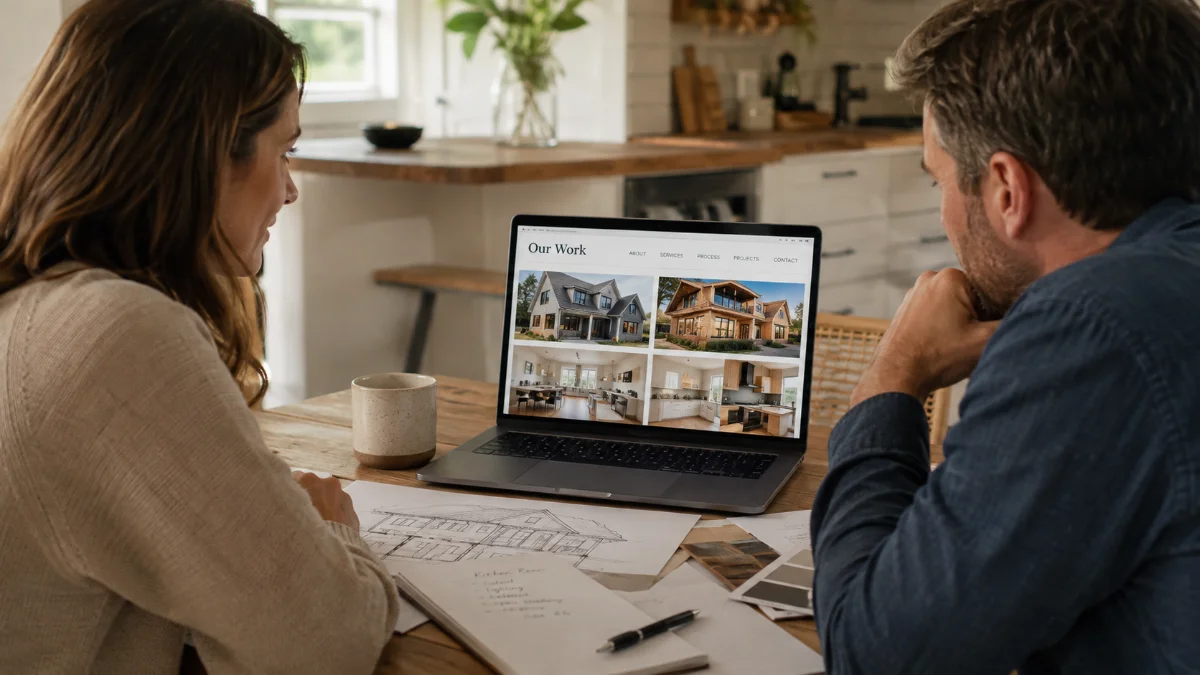
They browse your projects.
They may even compare you with two or three other builders.
By the time they contact you, they’ve already started deciding whether they trust you.
The sales process often begins long before the first phone call.
Building Work Is a High-Trust Purchase
Choosing where to buy lunch doesn’t require much research.
Choosing someone to renovate your home is different.
A homeowner may be considering spending hundreds of thousands of rand.
Their house may be partly demolished.
Their family may be living around the construction.
They may be dealing with you for months.
There’s considerable risk involved.
So they’re looking for reassurance.
Not just:
Can this person build?
But:
Can I trust this business with my home, money and time?
Step 1: They Search Your Name
Even when someone has referred you, the homeowner will often search your business name.
This is your first digital test.
They may find:
- Your website
- Google Business Profile
- Reviews
- Business directories
The stronger and more consistent that picture looks, the easier it becomes to trust the referral.
If nothing appears at all, the customer may wonder why.
Step 2: They Look at Your Work
This is usually high on the list.
A customer planning a renovation wants to see renovations.
Somebody planning a new home wants to see houses you’ve built.
They aren’t only looking for beautiful photographs.
They’re trying to answer:
Have these people handled a project like mine before?
This is why a properly organised portfolio matters.
Ten relevant projects are often more useful than a gallery containing a hundred random photographs.
Step 3: They Check Whether You Look Legitimate
Construction unfortunately has its share of bad stories.
Builders disappearing with deposits.
Projects left incomplete.
Arguments over money.
Poor workmanship.
This means legitimate building businesses sometimes have to work harder to prove they are legitimate.
Useful trust signals include:
- A professional website
- Genuine company information
- Relevant registrations
- Clear contact details
- Real project photographs
- Testimonials
- An established online presence
- Consistent business details
If you’re registered with relevant industry bodies, make that information easy to find.
Don’t assume the customer will ask.
Step 4: They Read Reviews
Reviews reduce uncertainty.
A prospective customer isn’t only interested in whether the finished bathroom looked good.
They may want to know:
Did the builder communicate?
Did they arrive when expected?
How did they handle problems?
Was the workmanship good?
Would the client use them again?
Those details are incredibly valuable.
And interestingly, a collection of genuine, detailed reviews is often more convincing than a wall of generic five-star praise.
Step 5: They Look at Who They’ll Be Dealing With
People like knowing who is behind a business.
This is particularly important when someone may be working in their home for months.
A good About page can introduce the owner, team or project manager.
It doesn’t need to be complicated.
Explain:
- Who you are
- How long you’ve been building
- What work you specialise in
- Where you operate
- What customers can expect
A real photograph helps too.
Customers generally trust people more easily than logos.
Step 6: They Compare You With Other Builders
Here’s the part businesses sometimes forget.
You aren’t being judged in isolation.
The homeowner may have three tabs open.
Builder A.
Builder B.
Builder C.
All three may be capable contractors.
But one website clearly shows:
- Relevant projects
- Customer reviews
- Service areas
- Company information
- Professional photographs
- Easy contact options
Another has a homepage built in 2016 and four blurry images.
Even if both companies are equally skilled, the customer doesn’t know that.
They can only judge the information available to them.
Step 7: They Decide Whether Contacting You Feels Easy
Finally, they’ve seen enough.
They want to talk.
Now don’t make the last step difficult.
Provide obvious contact options.
For many South African customers, that might include:
Phone
Request a Quote
Don’t hide your phone number on a contact page three clicks away.
And don’t make someone complete a fifteen-question form before they’re allowed to ask whether you work in their area.
Start the conversation first.
Your Website Doesn’t Need to Close the Deal
This is important.
A homeowner isn’t necessarily going to award you a building contract because your website looks good.
Nor should they.
There are still:
- Site visits
- Discussions
- Quotes
- References
- Contracts
- Timelines
Your website has a simpler job.
It needs to earn the next step.
It needs to make the potential customer think:
“This company looks credible. I want to speak to them.”
That is a very valuable job.
Think Like the Homeowner
Open your own website and pretend you’ve never heard of your business.
Ask yourself:
Can I tell what they build?
Can I see real projects?
Do they work in my area?
Do I know who they are?
Can I find evidence that customers trust them?
Can I contact them easily?
If the answers aren’t immediately obvious, that’s where the improvement needs to start.
Our builder website solutions are designed around exactly this buying process.
Because by the time the customer phones you, your website may already have done a surprising amount of the selling.

Build a website that works as hard as your business does.
Professional web design, practical digital support and a clearer path from online attention to real enquiries.

How South African small businesses can compete online
How South African Small Businesses Can Compete Online South African small businesses often compete against companies with bigger…
Read article
Website and Social Media Tips for Local Service Businesses: 10 Ways to Get More Enquiries
For a local service business, having a website and a Facebook or Instagram page is no longer enough.…
Read articleHow much does a small business website cost in South Africa?
How Much Does a Small Business Website Cost in South Africa? If you have started asking for website…
Read article