
How South African small businesses can compete online
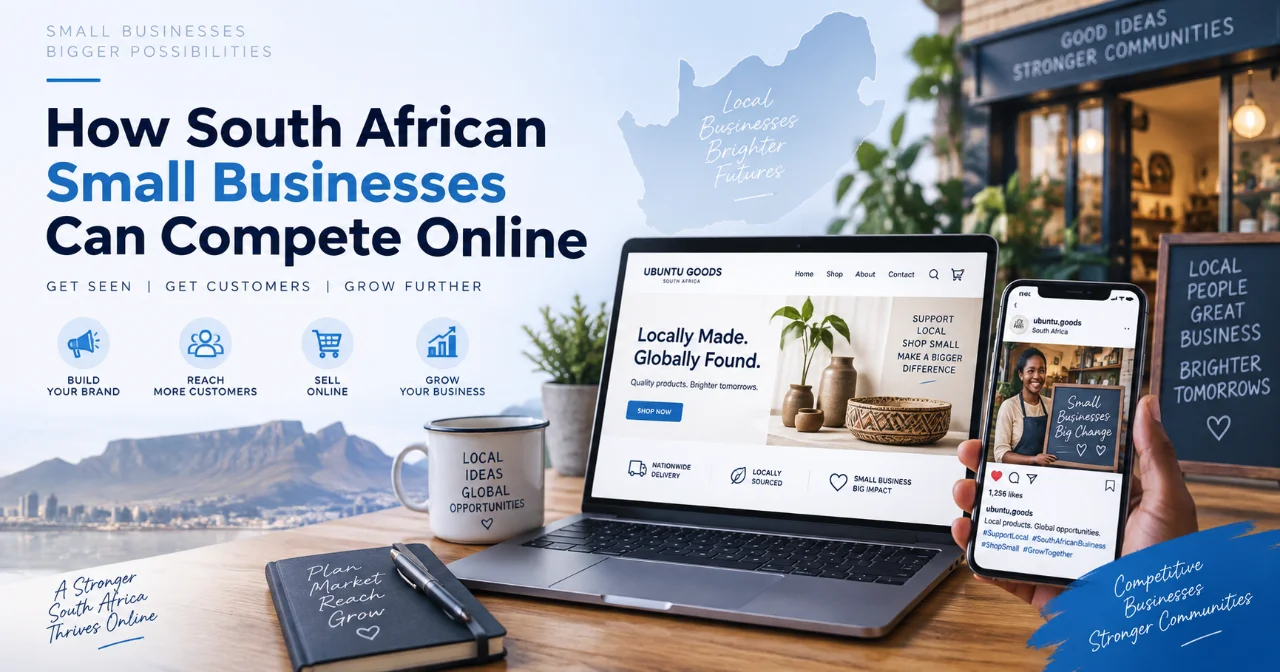
How South African Small Businesses Can Compete Online South African small businesses often compete against companies with bigger budgets, larger teams and established brands. Online, however, the playing…
In this article
- 1. Start with a website that actually works for the business
- 2. Compete locally before trying to compete nationally
- 3. Make Google work for you
- 4. Use real photographs wherever possible
- 5. Make mobile users a priority
- 6. Use social media to build familiarity and trust
- 7. Turn everyday work into marketing content
- 8. Make it extremely easy to contact you
- 9. Reliable internet is part of your business infrastructure
- 10. Build trust before asking for the sale
- 11. Stop competing only on price
- 12. Track what is actually generating business
- Small businesses do not need to look small online
- Want to know how your current website is performing?
How South African Small Businesses Can Compete Online
South African small businesses often compete against companies with bigger budgets, larger teams and established brands.
Online, however, the playing field can be much more level.
A small plumbing company in Worcester, a guesthouse in Tulbagh, an electrician in Cape Town or an independent retailer in Johannesburg can all appear alongside much larger competitors when potential customers search for their services.
The key is not trying to outspend bigger businesses.
It is about being easier to find, easier to trust and easier to contact.
Here are some practical ways South African small businesses can become more competitive online.
1. Start with a website that actually works for the business
A website should do more than simply confirm that your business exists.
It should help potential customers understand:
- What you offer
- Who you help
- Where you operate
- Why they should choose you
- How they can contact you
Many small business websites lose enquiries because this information is difficult to find.
Visitors should not need to search through several pages before discovering what services you provide or where you are based.
Your homepage should communicate the essentials within seconds.
For example:
Professional electrical installations and maintenance in Cape Town and surrounding areas.
That immediately tells the visitor what the business does and where it operates.
2. Compete locally before trying to compete nationally
One of the biggest advantages small businesses have is local relevance.
A national company may have a much larger marketing budget, but it cannot always match the local knowledge, personal service and proximity of a business operating in the community.
Use that advantage.
Your website should clearly mention the towns, suburbs or regions you serve.
If appropriate, create useful pages focusing on particular services and locations.
A plumber operating in Paarl, for example, could have content covering:
- Plumbing services in Paarl
- Emergency plumbing
- Geyser repairs
- Leak detection
- Bathroom renovations
This helps both potential customers and search engines understand exactly what the business offers.
3. Make Google work for you
When people need a local service, one of the first places they turn is Google.
That means your online presence needs to support the way people actually search.
Potential customers may search for phrases such as:
- electrician near me
- plumber in Worcester
- builders Cape Town
- guesthouses in Tulbagh
- estate agents in Stellenbosch
Your website should naturally include the services and areas people are likely to search for.
Your Google Business Profile should also be kept up to date with the correct contact details, opening hours, services, photographs and website link.
Reviews are particularly important.
A business with genuine recent reviews is often more reassuring than one with little or no visible customer feedback.
4. Use real photographs wherever possible
Stock photographs can make a website look polished, but real photographs create trust.
Show people what your business actually does.
This could include:
- Completed projects
- Before-and-after photographs
- Your team at work
- Products
- Your premises
- Vehicles
- Installations
- Customer projects
For service businesses in particular, completed work can be one of the strongest sales tools available.
A potential customer does not just want to hear that you do good work.
They want to see it.
5. Make mobile users a priority
Many South Africans will first encounter your business on a mobile phone.
Your website therefore needs to work properly on a smaller screen.
Check:
- Is the text easy to read?
- Does the menu work properly?
- Can visitors tap your phone number?
- Is there a WhatsApp option?
- Do the images load quickly?
- Can someone request a quote without struggling with a complicated form?
A website that is difficult to use on a phone can cost you enquiries.
6. Use social media to build familiarity and trust
Social media is not simply a place to advertise.
It is an opportunity to remind people that your business exists and demonstrate what you do.
Instead of constantly posting promotional messages, show the business in action.
A builder could post the progress of a renovation.
An electrician could explain a common electrical problem.
A guesthouse could show a nearby attraction.
An estate agent could share advice for homeowners preparing to sell.
A retailer could demonstrate a new product.
This creates useful content while continuously reinforcing your expertise.
When someone eventually needs your service, your business is more likely to come to mind.
7. Turn everyday work into marketing content
Small businesses often think content creation requires hours of extra work.
It does not have to.
Your normal working day already creates content.
A completed project can become:
- A Facebook post
- An Instagram post
- A website portfolio item
- A Google Business Profile update
- A short video
- A customer case study
- Material for a future blog article
One job can generate several pieces of marketing content.
The important thing is to develop the habit of recording your work.
Take photographs.
Make a short note about the problem.
Explain what you did.
Show the result.
8. Make it extremely easy to contact you
People are impatient online.
If a potential customer cannot quickly work out how to contact you, they may simply move to the next business.
Your website should have obvious contact options.
Depending on the business, this may include:
- Telephone
- Quote request form
- Booking form
- Directions
Your main call to action should also be clear.
Examples include:
Request a Quote
Call Us
Book a Consultation
Check Availability
Do not make visitors guess what they are supposed to do next.
9. Reliable internet is part of your business infrastructure
For many small businesses, internet access is no longer just an office convenience.
It supports email, cloud services, online banking, websites, social media, video calls, customer communication and increasingly the software used to run the business itself.
A slow or unreliable connection can therefore affect productivity as well as customer service.
If you are reviewing your business connectivity, you can compare fibre and internet options through Web Africa.
The important point is to treat connectivity as part of the infrastructure your business depends on, rather than simply another monthly expense.
Affiliate notice: The Web Africa link above is an affiliate link. Witzenberg Online may earn a commission if you sign up through it, at no additional cost to you.
10. Build trust before asking for the sale
Customers generally research businesses before making contact.
Your digital presence needs to answer the question:
Can I trust these people?
Trust can be built through:
- Customer reviews
- Testimonials
- Real project photographs
- Clear contact information
- Professional branding
- Accurate business information
- Qualifications and memberships
- Guarantees
- Case studies
- Useful advice
Small businesses often have an advantage here because customers can deal directly with the owner or a relatively small team.
Make that personal connection visible online.
11. Stop competing only on price
Trying to be the cheapest business online is usually difficult to sustain.
Instead, demonstrate value.
Show potential customers why your service is worth considering.
That might include:
- Faster response times
- Better workmanship
- Local knowledge
- Personal service
- Specialist expertise
- Guarantees
- Better communication
- Easier booking
- More transparent quotations
A professional online presence can help shift the conversation away from price alone.
12. Track what is actually generating business
Likes and follower numbers can be encouraging, but they are not the ultimate objective.
Look at the results that matter.
These could include:
- Website enquiries
- WhatsApp messages
- Phone calls
- Quote requests
- Online orders
- Bookings
- Email sign-ups
- Google searches
- Website traffic
If a particular page, social media post or campaign is generating enquiries, do more of it.
If something consistently produces no meaningful results, reconsider it.
Digital marketing works best when businesses continually learn from their own data.
Small businesses do not need to look small online
A customer visiting your website does not necessarily know how many employees you have or how large your office is.
They see the experience you present.
A well-built website, strong local visibility, genuine reviews, professional photographs and consistent social media can make a small business appear organised, credible and established.
That is one of the great opportunities the internet provides.
You do not necessarily need the biggest marketing budget.
You need to present your business clearly, show that you can solve the customer’s problem and make the next step easy.
Want to know how your current website is performing?
If you already have a website but are unsure whether it is helping your business compete online, start by reviewing what is working and what could be improved.
Witzenberg Online’s website check-up looks at the factors that can affect visibility, usability and customer enquiries.
Get your website check-up here:
https://witzenbergonline.co.za/web-checkup/

Build a website that works as hard as your business does.
Professional web design, practical digital support and a clearer path from online attention to real enquiries.
Website and Social Media Tips for Local Service Businesses: 10 Ways to Get More Enquiries
For a local service business, having a website and a Facebook or Instagram page is no longer enough.…
Read articleHow much does a small business website cost in South Africa?
How Much Does a Small Business Website Cost in South Africa? If you have started asking for website…
Read article
Google Business Profile vs a Plumbing Website: What Does Each Actually Do?
Google Business Profile vs a Plumbing Website: What Does Each Actually Do? “My plumbing business is already on…
Read article